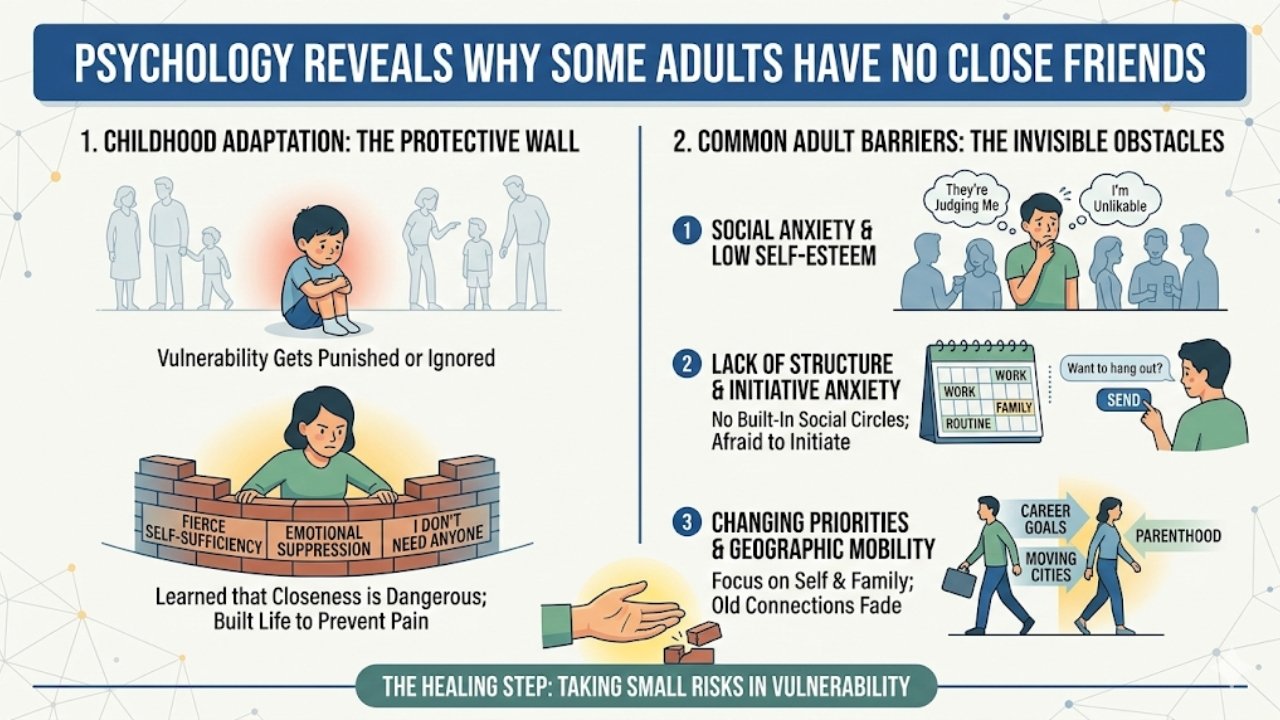
Many adults quietly live without any truly close friends, even while staying busy with work, family, and social media. Psychology shows this is rarely about being “unlikeable” and more about hidden patterns shaped by personality, upbringing, and modern lifestyles.
Childhood Experiences Shape Adult Connection
Early experiences with caregivers and peers strongly influence how safe or risky closeness feels later in life. Adults who grew up with emotional neglect, inconsistent affection, or bullying may learn to protect themselves by staying distant, even when they crave connection.
These patterns often show up as mistrust, difficulty reading social cues, or a constant fear of being rejected, which can make forming deep friendships feel exhausting rather than comforting.
Time Pressure and Overloaded Lives
Modern adulthood leaves little space for the slow work of building friendship. Careers, caregiving, commuting, and digital distractions all compete with the time and emotional energy needed to nurture close bonds.
As a result, many people maintain casual contacts but rarely invest in repeated, meaningful interactions, which are exactly what transform acquaintances into close friends.
Key Lifestyle Factors Linked to Fewer Close Friends
| Factor | How It Affects Friendships | Psychological Impact |
|---|---|---|
| Long work hours | Less time and energy to socialize. | Higher stress, emotional fatigue. |
| Frequent moving or job change | Disrupts existing social ties. | Sense of instability, reluctance to invest. |
| Heavy online engagement | Replaces in‑person connection with “weak ties”. | Feeling connected yet lonely. |
| Caregiving responsibilities | Limits flexibility for social plans. | Isolation, especially for parents and mid‑life adults. |
Fear of Vulnerability and Rejection
Close friendship requires letting others see our flaws, needs, and boundaries, which many adults find deeply uncomfortable. People who have been betrayed, judged, or abandoned may avoid opening up, keep conversations on the surface, or pull away when relationships start to deepen.
Social anxiety and fear of judgment can also block the first steps—initiating plans, sending messages, or joining new groups—so opportunities for closeness fade before they begin.
Hidden Behavioral Patterns That Push People Away
Psychology research describes a “loneliness loop,” where people who feel isolated develop negative expectations about others, then behave in guarded or distant ways that unintentionally confirm those fears. This might look like assuming others are not really interested, waiting for people to always reach out first, or retreating at the first sign of conflict.
On the other side, some adults expect instant intensity—wanting a new friend to feel like “family” within weeks—which can feel overwhelming and cause others to back off. Both extremes make it hard for friendships to grow at a natural, sustainable pace.
Social Isolation, Loneliness, and Mental Health
Not having close friends is strongly linked with loneliness, and chronic loneliness can feed a cycle of emotional withdrawal and low mood. Studies show that feeling isolated is associated with higher levels of depression, anxiety, and stress, as well as physical health risks over time.
In cultures where family networks are strong, such as in many parts of India, people may still feel lonely if they lack peers they can be emotionally honest with, especially during young and mid‑adulthood.
When Values and Identities No Longer Match
As people age, their beliefs, political views, and lifestyles can change, sometimes in very different directions from those around them. This growing polarisation makes it harder to maintain or start friendships across differences, because conversations can quickly feel tense or unsafe.
Adults may then avoid social spaces where conflict might arise, shrinking their social circle to a few neutral contacts and leaving them with no one they truly confide in.
Steps Toward Building Closer Friendships
Psychology suggests that even long‑standing patterns can shift with small, deliberate changes. Helpful steps include scheduling regular low‑pressure social time, practicing honest but gentle communication during minor conflicts, and challenging the assumption that rejection is inevitable.
Therapy, support groups, and community activities can also provide safe places to practice vulnerability and rebuild trust in others, gradually making it easier to form the kind of close friendships many adults quietly miss.
FAQs
Q1. Is it normal for adults to have no close friends?
Yes, it is common, especially during busy or transitional life stages, but it can still feel painful and affect well‑being.
Q2. Does having a partner replace the need for close friends?
No, romantic relationships cannot fully replace the unique support and perspective that close friendships provide.
Q3. Can someone who has always been lonely learn to make close friends?
Yes, with gradual exposure, new habits, and sometimes professional support, many people do learn to build and maintain close friendships later in life.