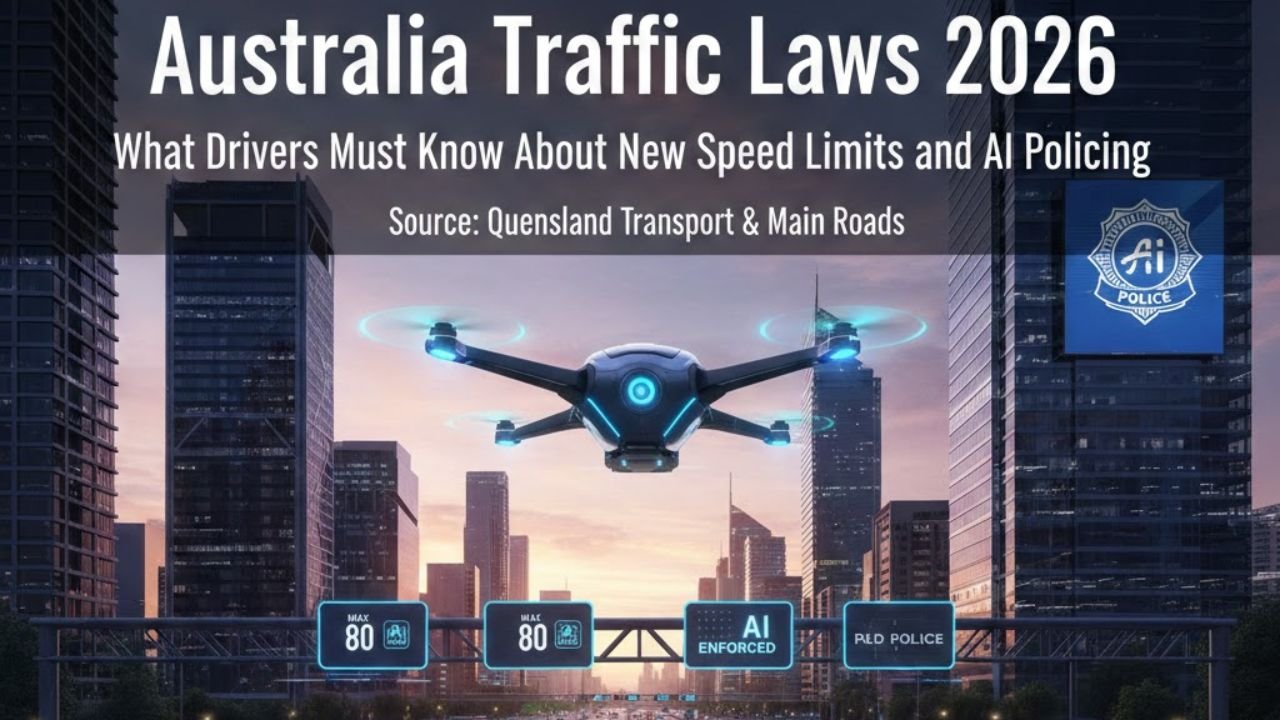
The Australian road landscape is undergoing a massive shift in 2026 as state and federal governments intensify their “Towards Zero” road safety strategy. For decades, traffic enforcement relied on visible police patrols and traditional radar, but the current year marks a definitive move toward a digital, automated future. These changes are not just incremental updates; they represent a fundamental overhaul of how speed is managed and how driver behavior is monitored. From the bustling streets of Sydney to the remote stretches of Western Australia, motorists are finding that the “margin for error” is shrinking. This guide explores the critical updates to speed limits, the rise of artificial intelligence in policing, and the new penalties that define Australian roads today.
The Downward Shift: New Urban Speed Limits
One of the most noticeable changes in 2026 is the widespread reduction of speed limits in high-activity areas. Across major cities, the traditional 50 km/h suburban limit is increasingly being replaced by 40 km/h or even 30 km/h zones. These “Safer Speed Settings” are strategically placed in shopping precincts, school zones, and high-pedestrian urban hubs. Research driving these changes suggests that the risk of a fatality drops significantly when impact speeds are kept below 40 km/h. While some drivers initially found the transition frustrating, the rollout is backed by a national framework designed to protect vulnerable road users like cyclists and pedestrians.
AI Surveillance: The Eye in the Sky
2026 is officially the year of AI-powered policing. Traditional speed cameras have evolved into sophisticated multi-function sensors that use machine learning to detect more than just velocity. These high-definition systems can now identify if a driver is touching a mobile phone—even if it is mounted in a cradle—or if a passenger is wearing their seatbelt incorrectly. In states like New South Wales and the ACT, these cameras operate 24/7 using infrared technology, ensuring that visibility or weather conditions no longer provide a shield for non-compliance. The sheer scale of detection is unprecedented, with AI capable of scanning thousands of vehicles per hour with near-perfect accuracy.
Average Speed Enforcement for Light Vehicles
A major legislative expansion this year involves the use of “point-to-point” or average speed cameras for passenger vehicles. Previously, these systems were largely reserved for heavy trucks to monitor long-distance fatigue and speed. However, several states have now activated these networks for all light vehicles on major highways. Instead of slowing down just for a visible camera and speeding up afterward, drivers must now maintain the legal limit over the entire length of a monitored corridor. If your average speed between two points exceeds the limit, a digital infringement is generated automatically, making it nearly impossible to “game” the system.
Understanding the 2026 Penalty Framework
The financial and licensing consequences of traffic violations have seen a sharp increase to keep pace with inflation and act as a stronger deterrent. In 2026, the cost of “distracted driving” is particularly high, reflecting the government’s crackdown on mobile phone use. Additionally, new “slow down and move over” laws have been expanded to protect more than just emergency vehicles; they now include tow trucks and roadside assistance vans.
The Digital License and Instant Notifications
The era of waiting weeks for a fine to arrive in the mail is coming to an end. By 2026, the Digital Driver’s License (DDL) has become the primary “source of truth” across the country. This digital integration allows for “instant” infringement processing. In many jurisdictions, drivers can now receive a notification of a traffic offence through their state transport app within hours of the incident. This rapid feedback loop is intended to change driver behavior immediately, though it also means that demerit points are applied and tracked in real-time, leading to faster license suspensions for repeat offenders.
Protection for Roadside Workers
A critical safety update in 2026 is the expansion of the “Slow Down, Move Over” rule. While motorists were previously required to slow down for police and ambulances, the law now encompasses all stationary vehicles with flashing lights, including garbage trucks, highway maintenance crews, and breakdown services like the NRMA or RACV. In most states, drivers must drop their speed to 40 km/h when passing these vehicles, while South Australia maintains a stricter 25 km/h limit. Failing to adhere to this can result in heavy fines and demerit points, as authorities prioritize the lives of those working just centimeters away from live traffic.
Older Drivers and New Medical Reviews
Safety reforms in 2026 also address the aging population with a unified national medical review framework. Drivers aged 75 and over are now subject to mandatory annual medical assessments to ensure they remain fit to drive. Rather than simply removing licenses, the system focuses on “conditional licenses,” which may restrict driving to daylight hours or local areas. This balanced approach ensures that senior citizens retain their independence while ensuring the safety of the broader community. These assessments are now standard across all Australian states, removing the previous confusion caused by varying state-by-state requirements.
FAQs
Q1 Are the new 30 km/h speed limits active everywhere?
No. These limits are currently restricted to specifically marked high-pedestrian urban hubs, certain shopping strips, and specific school zones. Always look for the posted signage.
Q2 Can AI cameras detect me using a phone at night?
Yes. Modern AI enforcement cameras use high-resolution sensors and infrared technology to detect mobile phone use and seatbelt violations 24/7, regardless of lighting or weather conditions.
Q3 What is the “move over” speed for breakdown vans?
In most Australian states, you must slow down to 40 km/h when passing any stationary vehicle with flashing lights. In South Australia, this limit is lower at 25 km/h.