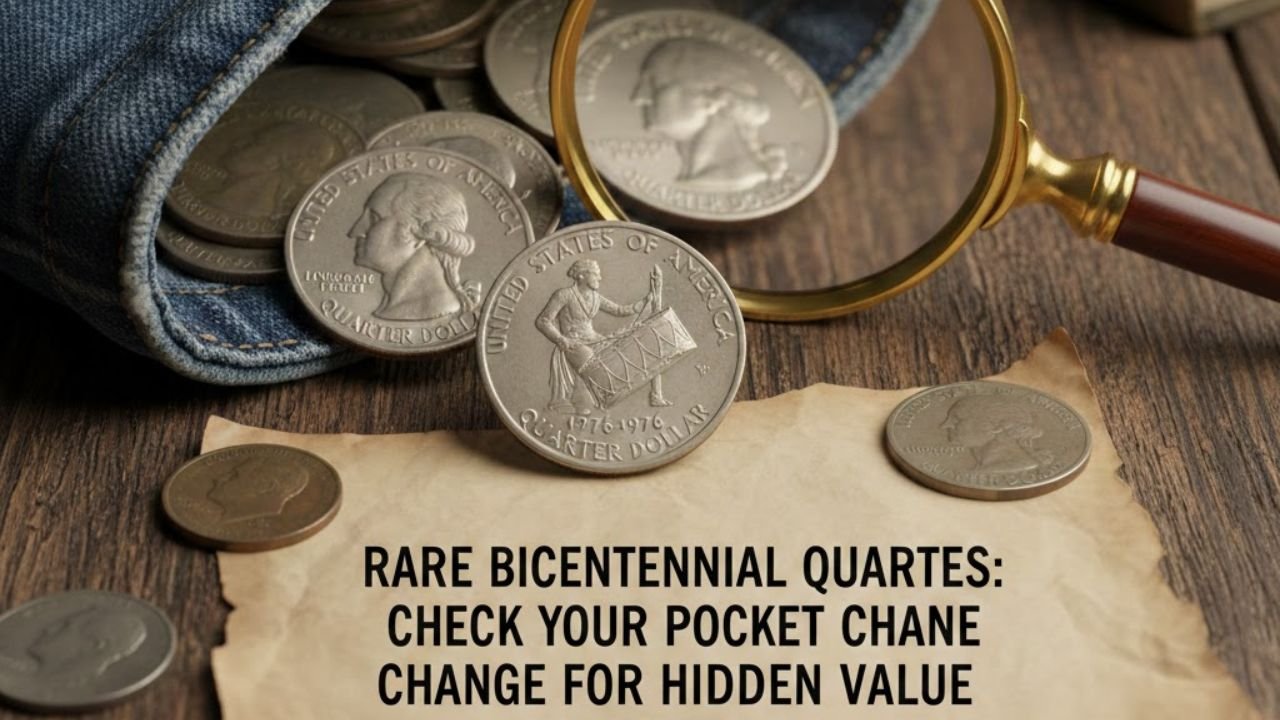
The 1776–1976 Bicentennial quarter is perhaps one of the most recognizable coins in American history, featuring the iconic colonial drummer on the reverse side. While the U.S. Mint produced nearly 1.6 billion of these coins to celebrate the nation’s 200th anniversary, most people assume they are only worth twenty-five cents. However, as we move through 2026, the market for these vintage coins has seen a significant uptick in interest. Serious collectors and casual hobbyists alike are scanning their jars of loose change for specific “hidden” versions that carry values far beyond their face amount. Understanding the nuances of mint marks, metal composition, and rare production errors is the key to identifying a true treasure from a standard circulating coin.
The Mystery of the Silver Composition
One of the primary factors that elevates a Bicentennial quarter’s value is its silver content. While the overwhelming majority of these coins found in circulation are made of a copper-nickel “clad” alloy, the San Francisco Mint produced a special 40% silver version specifically for collectors. These silver coins were originally sold in three-piece proof or uncirculated sets, but occasionally, they find their way into general circulation through broken sets or inheritance spending. You can identify these by looking for the “S” mint mark on the right side of the coin, just behind Washington’s ponytail. More importantly, check the edge of the coin; if you do not see a copper stripe and the edge appears solid silver, you may have found a coin worth significantly more than a quarter.
Valuable Errors and Doubled Die Varieties
Beyond metal composition, the most lucrative Bicentennial quarters are those with striking errors. The most famous of these is the 1976-D Doubled Die Obverse. On this rare variety, a misalignment during the minting process caused a distinct “doubling” effect on the lettering of the words “LIBERTY” and “IN GOD WE TRUST.” While some doubling is faint and requires a magnifying glass, prominent examples are highly sought after at auctions. Other valuable errors include off-center strikes, where the design is pushed to one side, or “filled D” mint marks where the center of the letter D appears solid due to a broken die. These mechanical hiccups turn a common commemorative piece into a unique historical artifact worth hundreds or even thousands of dollars.
Bicentennial Quarter Value Reference Table 2026
| Coin Variety | Mint Mark | Composition | Estimated Value (High Grade) |
| Standard Business Strike | None (P) or D | Copper-Nickel Clad | $0.25 – $5.00 |
| Silver Uncirculated | S | 40% Silver | $15.00 – $50.00 |
| Silver Proof | S | 40% Silver | $25.00 – $100.00 |
| Doubled Die Obverse | D | Copper-Nickel Clad | $500.00 – $3,000.00+ |
| Off-Center Strike Error | Any | Clad or Silver | $150.00 – $500.00 |
The Importance of Mint State Grading
For a Bicentennial quarter to reach its maximum financial potential, its physical condition must be nearly flawless. Professional grading services like PCGS or NGC use a 70-point scale to determine a coin’s quality. A coin that has been rattled around in a pocket for decades will likely grade as “Circulated,” keeping its value close to twenty-five cents. However, coins that have been preserved in “Mint State” (MS65 or higher) exhibit their original luster and lack the scratches or “bag marks” common in circulating currency. In recent years, an MS67 or MS68 grade Bicentennial quarter has sold for surprisingly high prices because so few of the 1.6 billion minted remained in perfect condition.
How to Spot the San Francisco Mint Mark
Finding the “S” mint mark is the first step for many treasure hunters. Unlike the “P” (Philadelphia) or “D” (Denver) marks which represent coins intended for the public, the “S” mark was reserved for the San Francisco Mint’s collector editions. If you find an “S” marked quarter that feels slightly heavier or looks more mirror-like than a standard coin, it is likely one of the silver or proof varieties. Even if it is not 40% silver, a cupro-nickel proof coin—which features a frosted design against a shiny background—still carries a premium over the standard versions you get at a grocery store.
The Rising Market for 1976 Commemoratives
As the United States celebrates its Semiquincentennial (250th anniversary) in 2026, nostalgia for the original Bicentennial coinage has surged. This increased demand has led to more competition among collectors to find high-grade specimens. Modern collectors are not just looking for silver; they are looking for “variety” coins that tell a story of the era’s manufacturing. Whether it is a “Drummer Boy” quarter with a unique die crack or a coin struck on the wrong metal planchet, the market is currently very active. This makes it the perfect time to go through your old coin jars or “piggy banks” to see if you have been sitting on a small fortune.
Proper Handling and Preservation Tips
If you believe you have discovered a rare or silver Bicentennial quarter, your first instinct might be to clean it. This is a critical mistake. Cleaning a coin with chemicals or abrasive cloths can permanently damage the surface and strip away its numismatic value. Instead, hold the coin by its edges to avoid getting finger oils on the faces. Place the coin in a protective plastic “flip” or a dedicated coin holder to prevent further scratching. If the coin appears to have a major error like significant doubling or an off-center strike, it may be worth paying for a professional authentication to secure its value in the marketplace.
FAQs
Q1 How can I tell if my 1776–1976 quarter is silver?
Check the edge of the coin for a copper-colored stripe. If the edge is solid silver-white, it is likely 40% silver. You can also weigh it; silver quarters weigh 5.75 grams, while clad ones weigh 5.67 grams.
Q2 Are all Bicentennial quarters rare?
No, most are very common because over 1.5 billion were minted. Only those with the “S” mint mark, specific minting errors, or those in absolute perfect “Mint State” condition are considered rare or valuable.
Q3 Where is the mint mark located on the Bicentennial quarter?
The mint mark (P, D, or S) is located on the obverse (front) side of the coin, just to the right of George Washington’s neck, above the date.